Discover the AI Usage Classifications™ Standard

Purpose-built language for transparent, consistent AI disclosure

Purpose

Why the Standard exists

The AI Usage Classification™ (AIUC) exists to promote transparency, accountability, and clarity in how artificial intelligence is applied across different domains of work. Its purpose is not to evaluate the quality or ethics of AI use, but to provide a simple, shared language for organisations and individuals to describe the level of AI involvement in the generation, creation, design or development of artefacts, content, and products.

By supporting honest disclosure, the classifications enable stakeholders — including clients, regulators, consumers and communities — to understand when and how AI is used, fostering trust, informed engagement, and responsible innovation.

Scope

Available to organisations and individuals with approved registration, for use on artefacts, content or products that have been generated, created, designed, developed, or executed. Read alongside the Code of Practice.

Implementation

Requires a structured approach. Organisations should consider what levels of AI involvement are appropriate for their products, regulatory environment, and customer expectations before rolling out.
AIUC Global
Benefits

Why adopt the Classifications?

Promote Transparency

A consistent language for disclosing the role of AI in professional, personal and creative settings, helping stakeholders understand the various levels of human involvement.

Enhance Stakeholder Confidence

Signal your commitment to ethical, transparent and well-governed AI practices, building trust with clients, regulators and the public.

Align with Policy

Help organisations align internal AI use with their policies, risk appetite and sector expectations without imposing restrictive or value-laden judgements.

Support Efficient Operations

Encourage responsible use and experimentation with AI while maintaining accountability through appropriate classification and review.

Core Classifications

Five classifications to declare AI-Human involvement

Use the tabs below to understand definitions and practical applications. Examples are for demonstration purposes only and do not indicate verified authorship or provenance.

AI-Free Badge

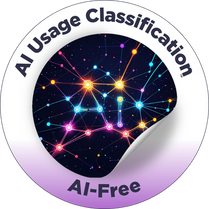
AI-Free

When no AI is used in the generation, creation, design or development of the artefact, content, product or process.

  • A handmade sketch drawn entirely by an artist using traditional pencils and paper.
  • A business plan written solely by a human strategist through manual drafting and revisions.
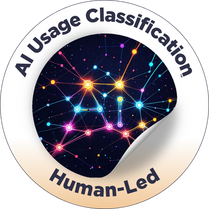
Human-Led Badge

Human-Led

When AI has been used to make minor tweaks, optimisations or corrections without changing the original intent in the generation, creation, design or development.

  • A report authored by a team, with AI only used for spell-checking and basic formatting.
  • A photograph edited manually, where AI auto-corrected minor colour balance issues.
Co-Created Badge

Co-Created

When AI has supported the iterative generation, creation, design or development of the artefact, content, product or process.

  • A blog post where a writer used AI prompts multiple times to refine drafts collaboratively.
  • A logo design iterated through human sketches combined with AI-generated variations.
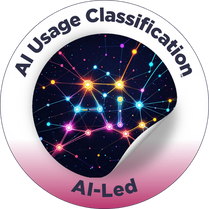
AI-Led Badge

AI-Led

When a human has made minor adjustments to an artefact that has been entirely generated, created, designed or developed by AI.

  • An AI-generated project timeline, with a manager only adjusting a few deadline dates.
  • A cover letter drafted fully by AI, lightly edited by the applicant for personal tone tweaks.
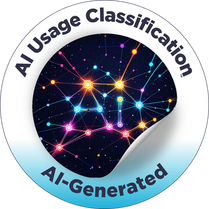
AI-Generated Badge

AI-Generated

When AI has been used to entirely generate, create, design or develop the artefact, content, product or process.

  • A digital painting produced directly from a text prompt in an AI image generator, with no human edits.
  • A full marketing email sequence created end-to-end by an AI copywriting tool.
Variation Categories

Three variation modifiers

Applied on top of a core classification when additional context is required.

Uncontrolled Badge

Uncontrolled

When documents are released in an editable format outside the licensee's control, indicating the artefact was editable when classified and may be modified externally.

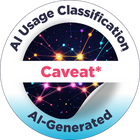
Caveat Badge

Caveat*

When a sub-classification is required within an artefact that differs from the main classification, applied to that section only without altering the overall artefact classification.

Uncontrolled Caveat Badge

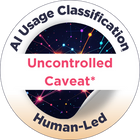
Uncontrolled Caveat*

When an artefact is released in editable format and contains specific sub-sections with distinct classifications that differ from the overall classification.

Ready to get access?

As part of the licence registration process, you will receive access to the applicable set of badges for use in your products, artefacts, or content as per the Code of Practice.